Building a Reproducible Sparse Matrix Benchmark on Hyak
SparseBench++ started as a correctness-first sparse matrix benchmark harness, not as a claim that a new SpMV kernel would immediately beat mature libraries. The first useful goal was narrower and more valuable: take a C++ CSR SpMV implementation from tiny checked-in fixtures to real SuiteSparse inputs on Hyak, the University of Washington research computing cluster, without losing track of what was actually run.
That framing mattered because performance numbers are easy to overstate. A fast-looking benchmark is not useful if the data path is unclear, the batch job silently used a fallback matrix, or the result directory cannot be tied back to a commit. The project now has a traceable path from parser tests to Slurm jobs, CSV output, analysis summaries, and report figures.
From Tiny Fixtures To Real Matrices
The first fixtures were deliberately small Matrix Market files under data/tiny/. They made parser behavior easy to test and kept local CTest runs cheap. That mattered later: when the Slurm mechanics were working, the SuiteSparse downloader exposed the real parser boundary. The first small SuiteSparse set was not just coordinate real general.
That pushed the parser from the original narrow format into the current v0.1.1 coverage:
coordinate real generalcoordinate integer generalcoordinate pattern generalcoordinate real symmetric
Unsupported Matrix Market variants still fail instead of being silently misread. That is less glamorous than accepting everything, but it is the right default for a benchmark harness. Wrong input handling contaminates every timing number downstream, and a benchmark harness should make that kind of failure loud.
Slurm As A Gate, Not Just A Launcher
The Hyak scripts evolved into gates, not just launchers. The real benchmark jobs validate the manifest, refuse diag5.mtx fallback input, build on compute nodes, run CTest, and only then emit CSVs.
For the medium scaling pass, the manifest was:
/gscratch/scrubbed/junyej/sparsebench/data/medium_matrices.txt
It contained six SuiteSparse matrices: cant, consph, cop20k_A, mac_econ_fwd500, mc2depi, and pdb1HYS. That same manifest is now the controlled input for both the 96-core SparseBench scaling run and the 32-core Eigen comparison.
96-Core SparseBench Scaling
Job 34825519 ran the SparseBench CSR SpMV path on cpu-g2-mem2x with 96 allocated CPUs and thread counts 1,2,4,8,16,32,64,96. It completed with CTest 3/3, empty stderr, and 48 CSV files.
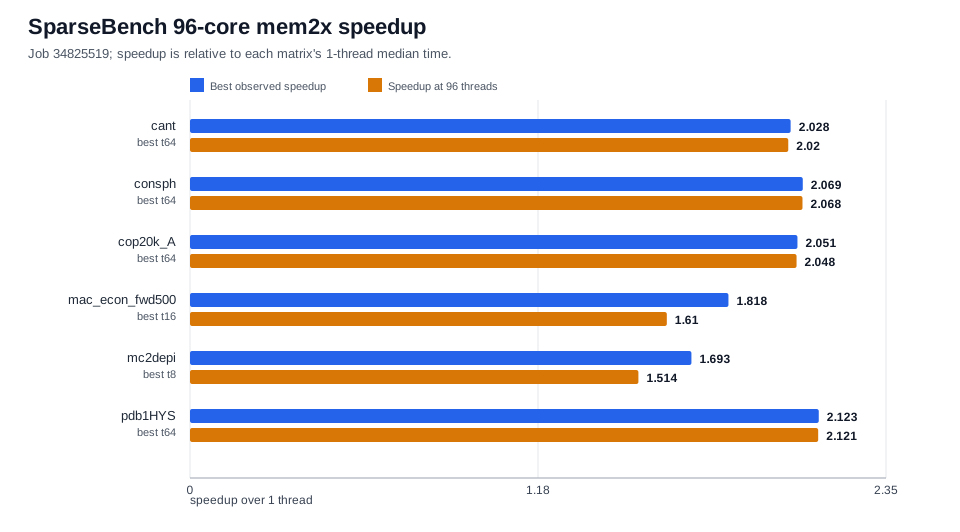
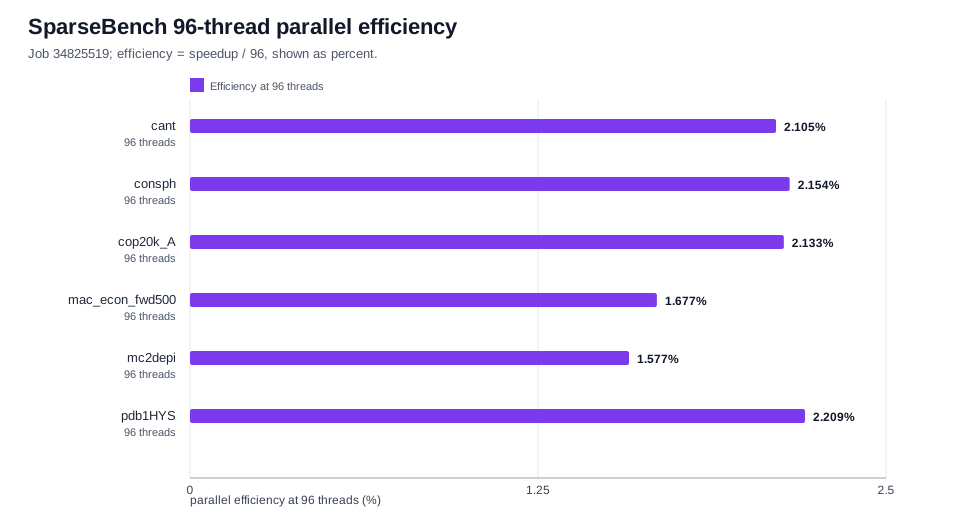
The result is useful, but it is not a linear-scaling story. Best observed speedups ranged from 1.693x to 2.123x, and every matrix peaked before 96 threads. The efficiency plot makes the same point from another angle: this CSR SpMV path is dominated by memory traffic and sparsity-pattern effects, not floating-point throughput.
The important result for this stage is more mechanical than glamorous. The same build, test, manifest, and CSV pipeline can now carry future experiments without asking readers to trust an informal spreadsheet.
Adding A Real Baseline
After the SparseBench-only scaling run, the next useful question was not whether SparseBench was “fast” in isolation. It was how the current implementation compared with an established sparse backend on the same inputs, under the same manifest discipline.
Job 34852262 added an Eigen baseline on cpu-g2. It built with SPARSEBENCH_USE_EIGEN=ON, loaded cesg/eigen/3.3.9, ran both backends on the same six matrices, and produced 72 paired CSV files across thread counts 1,2,4,8,16,32.
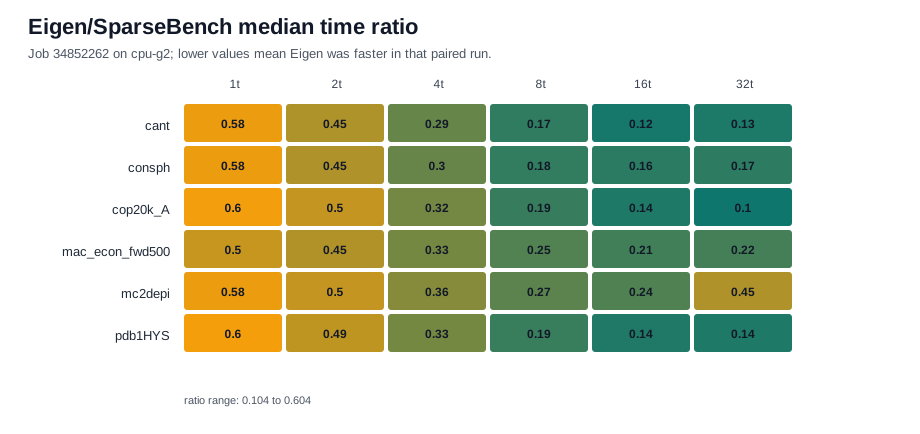
In that run, Eigen won all 36/36 paired matrix/thread comparisons. That is a useful engineering signal, not a defeat. It says the current SparseBench path is now stable enough to compare honestly, and it gives a concrete optimization target instead of a vague feeling that the kernel should be faster.
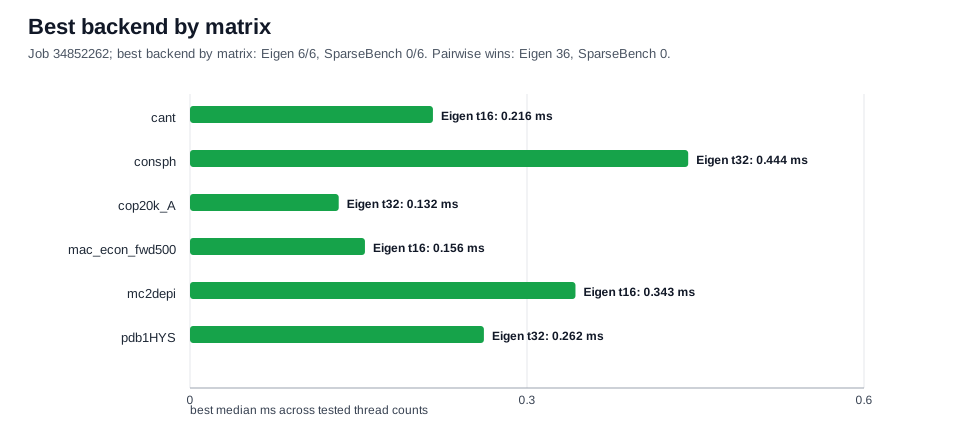
The Eigen run is intentionally labeled as a 32-core cpu-g2 comparison. It is not evidence for the pending 192-core cpu-g2-mem2x probe, and its absolute times should not be mixed with the separate mem2x scaling job.
What Is Still Pending
The 192-core probe is job 34851174. It is still pending with QOSGrpCpuLimit, has no allocation, and has produced no result CSVs. It should stay out of benchmark claims until it completes and passes the same checks: Slurm COMPLETED 0:0, clean stderr, CTest, and the expected matrix/thread coverage.
What Comes Next
The immediate next step is preservation: the 34852262 Eigen evidence lives under /gscratch/scrubbed, which is disposable scratch. It should be packaged or mirrored before that storage is cleaned.
After that, the path is clear:
- Keep tracking the 192-core probe and report it only if it completes cleanly.
- Add more external baselines once Eigen is stable.
- Use the current report pipeline for future figures instead of hand-copying raw data.
- Delay CG and Lanczos until the SpMV reporting workflow is boring and repeatable.
That is the main lesson from this pass: the project is still small, and Eigen is currently faster on the measured comparisons, but the evidence chain is now strong enough to build on. That is the part I wanted from this stage.